
OSU’s Division of Educational Ventures marks a year of measurable impact advancing access, affordability and student success through research and bold initiatives
I was given an impossible task.
Someone recently asked me to identify what I enjoy most about leading Oregon State University’s Division of Educational Ventures. The truth is, there is no tidy answer. Our division is involved in hands-on work that has wide-ranging impacts.
Every day, we serve in a variety of roles that directly influence the experience and success of Oregon State students who learn online. We lead initiatives that make student learning more affordable at OSU and beyond. We partner closely with OSU faculty to develop high-quality online courses. We develop innovative educational pathways that give modern learners better access to life-changing opportunities. We conduct original, award-winning research that advances the field of online teaching and learning. And we collaborate with industry to identify solutions that solve workforce needs.
There isn’t one thing I enjoy most about our division’s work because it all makes a tangible difference, in a variety of ways, throughout Oregon and around the world. The same is true of our many accomplishments in 2025. It was a year marked by significant achievements as we innovate for access and success on all fronts.
With that in mind, we’d like to highlight some of our division’s most notable initiatives and successes of the past 12 months. And in the spirit of knowledge-sharing, each item below includes a recommendation with guidance on how you can begin to implement similar practices in your unit or at your institution.

1. Ecampus redefines student success, earns national innovation award
The summary
In June, Ecampus earned the prestigious Eduventures Innovation Award for our groundbreaking work in redefining how student success is measured and supported in online education. We received this honor in the outcomes award category for our initiative titled “Utilizing mission, data and policies to define and track online student success metrics.”
The initiative reflects Oregon State’s deep commitment to student-centered innovation and institutional excellence.
The impact
Drawing from institutional policies, student survey data and national benchmarks, our student success team and data analysts created a set of metrics that reflect what success truly looks like for Oregon State’s online learners. These include persistence rates, course mastery, academic excellence, a sense of belonging and degree completion.
Our recommendation
“Revisit your university’s online student success metrics by centering them on real student experiences and incorporating the student voice — not just generic KPIs. Start by convening cross-functional teams (student services leadership, data analysts, etc.) to co-define a holistic success framework that includes persistence, mastery, belonging and progress. Be sure that you’re not focusing so intently on time-to-degree. Then, regularly share and act upon that data to build continuous improvement.” — Marleigh Perez, senior director of student success, Ecampus
2. Creation of Workforce Advisory Board gives OSU an additional direct pipeline to industry insights
The summary
To help strengthen the connection between higher education and industry needs, our Corporate and Workforce Education Unit established a Workforce Advisory Board that will provide OSU with expert guidance and recommendations from leaders at some of the world’s most successful and respected companies:
- Amazon
- Columbia Bank
- Columbia Sportswear
- GE Aerospace
- GHD
- JPMorgan Chase
- Krispy Kreme
- Microsoft
- Nike
- NVIDIA
- Providence Health & Services
- Target
- Tillamook
The impact
Members of the Workforce Advisory Board will offer strategic insights to help Oregon State develop and align its holistic educational offerings with workforce demands, ensuring that learners develop workforce-ready skills that build successful careers and support industry talent pipelines. Our division will share these insights with OSU’s colleges, which often have their own industry boards for effective feedback coordination.
Our recommendation
“Identify the right organizations and the optimal roles you want represented on an advisory board; Oregon State prioritized having many industry verticals at the table. Our desired impact is to help OSU develop and align holistic educational offerings across colleges with workforce demands in support of industry talent pipelines. We want to share high-value industry insights with the relevant partners across the university, particularly the colleges who develop courses and learning content.” — Howard Burns, senior director, Corporate and Workforce Education Unit

3. Open educational resources help OSU students save $12.25 million
The summary
In March 2025, Oregon State’s Open Educational Resources Unit surveyed OSU students to discover the true impact of course materials costs on students’ academic and personal lives. The majority of respondents reported being worried about their ability to pay for course materials.
Surveys like this help deepen our understanding of learners’ academic journeys, and they help us develop strategies to make learning more affordable and accessible. The OER Unit works with OSU faculty to develop openly licensed, free course materials, and we track low-cost and no-cost course offerings for online and in-person classes.
The impact
More than 195,000 Oregon State students (duplicated headcount) were enrolled in at least one course section that used low-cost (under $40) or no-cost learning materials in academic year 2024-25. This gave struggling students more resources to spend on basic needs such as food and rent, based on survey responses.
Here is more OSU data from this past year:
- Total estimated student savings: $12.25 million
- Low-cost sections: 1,478 (14%)
- No-cost sections: 4,208 (41%)
- Sections reporting using OER (included in no-cost sections): 310 sections, impacting 18,107 students (unduplicated headcount)
Our recommendation
“Consider the total cost to students, both academic and personal, when choosing required course materials and reach out to your school’s OER director or the library to find alternative low or no cost resources. Report all required course materials including textbooks, software, equipment, etc., to the bookstore or necessary people, even when you are using low- or no-cost course materials because it helps students make informed financial decisions when registering.” — Stefanie Buck, director, Open Educational Resources Unit

4. Ecampus launches 15 new online programs in high-demand fields
The summary
Not only are we focused on developing new, alternative pathways to earning an OSU credential, but we’re also expanding access to high-quality learning opportunities in more traditional offerings. In partnership with OSU’s academic colleges, Ecampus launched 15 new online degree and certificate programs in the 2025 calendar year — and announced in-progress efforts to launch many more in 2026.
The impact
These new programs give students opportunities to break into in-demand fields such as electrical and computer engineering, healthcare administration, special education, clinical psychology and chemical engineering. This extensive program growth meets learner needs and enables Oregon State to work toward the enrollment goals outlined in the university’s Prosperity Widely Shared strategic plan.
And importantly, all courses delivered online are taught by Oregon State faculty — not AI.
Our recommendation
“Conduct market research and leverage your partnerships — both at your institution and with industry — to identify programs that align with learner and workforce needs. Focus on programs that will help learners obtain the skills they need to be employable. Increasing enrollment is an important and worthwhile goal, but focus on developing pathways that better serve place-bound students and those who may not otherwise be able to finish their degree.” — Lisa L. Templeton, vice provost, Division of Educational Ventures

5. Alternative credentials fuel rapid growth, learner access to specialized skills
The summary
This past year we began to see the benefits of a coordinated, institution-level approach to alternative credentials, driven by improvements to data structures, processes and emerging strategies. In collaboration with partners across Oregon State, our work in the alternative credentials space enables OSU to better meet the needs of modern learners; directly support the university’s goal to increase learning access and affordability; and stay responsive to workforce needs.
The impact
We witnessed a 67% year-over-year enrollment increase (1,234 to 2,070) in OSU’s credit-bearing microcredentials. These short-form offerings allow learners to build specialized, in-demand skills and earn a digital badge in (usually) three courses. In AY25, we launched nine new microcredentials. So far in AY26, we’ve launched 17 more.
This includes a collection of interdisciplinary AI fundamentals microcredentials that introduces students to AI and machine learning fundamentals, AI ethics and industry-specific applications.
Our recommendation
“Continue to expand the success of credit-bearing microcredentials by ensuring course content stays aligned with in-demand workforce skills. Build course schedules with working adults and microcredential-only students in mind to improve access and completion. And most importantly, foster strong college-level support and collaboration — it’s the key to sustaining growth and creating meaningful learning opportunities for every type of student.” — Devin Miles, director, Alternative Credentials Unit

6. OSU celebrates 10-year anniversary of Ecampus Research Fellows Program
The summary
We’re proud that Oregon State is home to one of the only research units attached to an online education division. And in 2025, we celebrated 10 years of the Ecampus Research Fellows Program, which provides OSU faculty with research grants of up to $25,000, along with structured support and training.
The original research produced by the fellows — and the Ecampus Research Unit as a whole — significantly impacts the online teaching and learning efforts at OSU and beyond.
The impact
In the past decade, 48 research projects from 75 Oregon State faculty members have been funded through the Research Fellows Program. Those studies have been linked to three federal grants, 10 peer-reviewed publications and $1 million in federal grants. Faculty from nine OSU colleges have participated in the program since its inception, studying topics such as peer-reviewed writing, generative AI, 3D models and video segmentation.
Our recommendation
“Consider ways that you can fund or otherwise support your faculty in conducting research on teaching and learning on your campus.” — Mary Ellen Dello Stritto, director, Ecampus Research Unit

7. Faculty partnerships bolster online education excellence, student experience
The summary
As a university, we strengthened our excellence in online teaching and online course development each quarter, thanks to our continuous improvement model and the ongoing collaboration between 1,300 OSU faculty members and Ecampus instructional designers and multimedia developers. The process of developing and redeveloping online courses often includes the creation of interactive multimedia tools that make student learning experiences more engaging.
The impact
Ecampus staff and Oregon State faculty introduced a wide variety of new innovations in online course design. This includes a GroupFinder tool that uses a customizable, algorithm-based system across multiple courses to help — among other things — new and transfer students find peers with similar interests and stay in touch throughout their time at OSU. Other innovations include a custom creative writing workshop tool, a virtual surveying instrument for a construction engineering course, and a hands-on simulation to apply environmental conditions to plants.
Our recommendation
“Apply a rigorous, collaborative approach to course development to ensure students receive high-quality learning experiences online. When you intentionally design online courses, students will see how each part of the course fits into their overall learning goals. Well-designed courses give students opportunities to engage with the content, the instructor and each other.” — Karen Watté, senior director of course development and training, Ecampus
8. Ecampus Student Advisory Board creates new opportunities for advocacy, dialogue
The summary
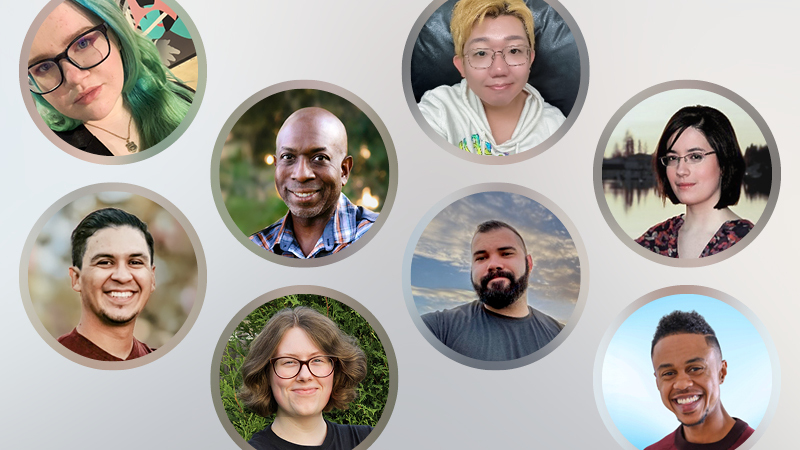
Amplifying student voices is great, but we took it to a new level by creating the Ecampus Student Advisory Board to give online learners actual seats at the table. This 12-member board played a major role in improving the online learning experience by partnering with OSU leadership, taking part in leadership development activities and connecting with students, faculty and staff.
The impact
With students from the U.S., South Africa and the Netherlands, the board convened 16 times to share insights with Ecampus staff on vital topics such as student belonging, accessibility and learning affordability. Members also launched a blog series, served on a university-level budget committee and helped shape critical conversations related to student fees and tuition.
The SAB members also served as a focus group for OSU’s Mental Health Task Force. They provided their recommendations — based on their unique student perspectives — to improve mental health support for online learners.
Our recommendation
“As institutions of higher learning, we must commit to online student success. This means providing students with spaces for advocacy and dialogue. While student success metrics offer critical insights for informed decision-making, we must also listen to our distance learner if we truly wish to create meaningful change.” — Eddie Rodriguez, student program manager, Ecampus
A look at 2026 and beyond for the Division of Educational Ventures
On the heels of a successful year, our division will continue to build on this momentum by advancing Oregon State’s leadership in innovative education delivery, expanding access and affordability, and responding with agility to workforce and learner needs. By using data and student voice to inform decision-making, our focus will remain the same: to create meaningful, high-quality learning pathways that support student success and extend the reach and impact of Oregon State University.


